Tuesday, April 2, 2019

NaPoWriMo Day 2: "My Mother's Back"

April 2, 2019

The NaPoWriMo prompt for today which I used begins with the example of an unsettled, dream-like poem that asks questions and ends in a question. The prompt asks us to "write a poem that similarly resists closure by ending on a question, inviting the reader to continue the process of reading (and, in some ways, writing) the poem even after the poem ends."

In my initial vision of the poem I was going to write, I envisioned starting with descriptions and statements and moving into a series of questions. But as I wrote, the directly stated parts felt flat or overly narrative and naive, so I ended up just keeping and expanding the questions into a poem that is composed of nothing else. I could play with the lines and images for a lot longer than I've done, I'm sure. To speak of what my family rarely mentioned and I rarely let myself see is exhausting, so I'll stop with it as is for now.

Early on, the thought of Robert Hass's arresting poem "My Mother's Nipples" began tugging at my mind, especially its bizarrely playful use of rhymed partly-French lines. Once I got the rhyme of mystère and mère in my head they were stuck there. So for now I've left the line that came to me as an epigraph and tribute.


My Mother’s Back

C’est un mystère, le dos de ma mère.

How old was she when it began to rise and twist?
When she chose school over the rigid brace
And slung a hump over her shoulder for the duration?

Was her back a tree growing into a stiff wind?
Was it weighted by centuries of Jewish fear?
Was it handed down from a seamstress in Bialystok
Or from a rabbi hunched over his books?
Was it the curled rage of generations of brainy girls
Or the gray arch of a smashed tombstone?
Was it hard and loud as a high heel?

Was her back the breaching of a white whale,
A snowy mound, signifying the ultimate?
Was it a monstrous regiment of women?
Was it a wild mare rearing?

Was it full of stories that were never told?
Did it cry silently at night, yearning to be held?
Was it the skyline of New York from the Jersey side?
Was it a look back at the rocky Palisades?
Did it refuse to be comforted by my father’s hands?

Did it buzz with urgency? Was it swelled with feelings
She never seemed to have? A carrying case
Of everything about her life I couldn’t ask?
Was it a box of unsold candy from her father’s cart?

Was it whatever she cold-shouldered to go on?
Was it a fortress? Was it a temple?
Was it the speckled dark side of the moon?

Was it what she passed to me to carry out of view,
The heaviness, the ache, the drag of longing?
Was it the pack I have to hoist at last?
Was it a secret calling, the journey waiting,
Was it the unwritten poem, is it in these words?


--Draft by Anne Myles. Do not quote or cite without permission.

Monday, April 1, 2019

NaPoWriMo Day 1: "How to Write in Meter" 4/1/2019

So, the blog is back, at least for the time being, after being on hiatus since last July. Once I started writing poetry it's what I wanted to blog about, and I wanted to share poems, but then I realized that those are considered "published" and I had to take them down if I was going to send them out to journals, and it all seemed rather depressing. Which it still does, from that angle. But I sort of miss doing it all the same. I may pick up more after I retire (!!!) in May.

However, crazy as it is in a busy month, I've decided to try NaPoWriMo, National Poetry Writing Month, and I need a place to post poems in some kind of gathering. So obviously this is the place. I will take down the posts later if and when I send any of these out.

Writing a poem a day feels very intimidating to me, although I am greatly inspired by Vince Gotera, who is a master at it, and his collection of NaPoWriMo poems, The Coolest Month, is officially out today. But I think it will be good for me, to build my chops, to get out of the sense that everything I write has to be great/deep/potentially publishable or I'm not good. And it will help me stockpile some ideas and drafts for the MFA I'm beginning this summer.

If anyone wants to get involved, the two sites doing (different) daily prompts for April are the official site at NaPoWriMo.net and Robert Lee Brewer's Poetic Asides blog.

Today's NaNoWriMo prompt:  Write a poem that provides the reader with instructions on how to do something.

My poem is pretty meta, as it's about writing poetry. But it wasn't so much that I was trying to be clever, rather that it's the subject that immediately jumped into my mind. I just taught a class in writing in meter on Saturday as part of the monthly poetry series I'm teaching, so the gist of these instructions was something I actually said (minus the imagery of course -- certainly minus the sex part!). And I love meter and it's something I get excited to introduce to others.

The meter is basically iambic here with natural variations, but there's a trochaic line and an anapestic line, both inserted on purpose and related to the subjects described -- trochees always feel to me like a stamping dance, and anapests like a horse cantering.

The line lengths aren't uniform in terms of number of feet -- I'm letting myself go with that, though it bothers me, as I can only even begin to fit this in to my months if I don't obsessively revise.  Letting poems be imperfect (for now) is one of the reasons I think doing this will be good for me.


How to Write in Meter


The secret is, I told the workshop students,
don’t think about it. Analyzing is a later move;
your brain won’t get you there; you have to feel it
in your breath, your body. Heart that beats, lub-dup,
the pulse that throbs, that other pulse of coming.
That time you strode the city, full of your intent.
Cajun dancing with that wild man at the festival --
how you’d fall for him and finally fuck him too
after so many years, for all you disapproved.
You must recall a horse you loved in childhood,
how you cantered across the wet fields, with that scent
of crushed wild onion blooming in the air.


Tuesday, July 3, 2018

The End and the Beginning


July 1 marked the official end of my semester of leave. It is summer now, of course, so fortunately my return to my UNI work life will be gradual -- I need to go in to the graduate office one a week or so, but things won't get busier until August. And I still have one week-long writing workshop left this month!

I admit that I am struggling deeply with how little I want to go back, and how stressful the fall semester will be -- not so much the teaching part, but some big things related to the graduate program that got set in motion while I was gone I will need to attend to quickly, and the fact that (after much struggle and reluctance) I agreed to write the chapter on "Dissent" for a Cambridge UP volume, New Histories of Puritan American Literature, that colleagues are doing, and a draft of that is due by December 1. Going back to academic writing is going to be dreadfully distasteful, and this in particular involves a kind of general writing I have never done before (and know well is not my strong suit), plus refamiliarizing myself with both primary and secondary texts I haven't looked at for years. I am truly not sure whether I want to continue with any academic writing after this, though, so I am looking at it as a chance to spend conscious time with my feelings about such work, and to write a worthy "swan song" if in fact I don't continue.

I don't know how to describe how important and transformative the past six months have been for me. Or I could describe it, but it would involve writing at length, and what I have gone through feels personal and sacred and still tenderly new in ways that make me not want to spell it all out in detail. Anyone who has read this blog has a sense of it. My project idea fell apart (as a longer-form project), but it uncovered so much about what I do want to write about, and brought so many key pieces of my early adult past back with tremendous vividness. Poetry came back, of course, which matters even more. Something I had been intensely emotionally attached (addicted?) to collapsed and underneath that I found new ways of being, more vital and sustaining. Writing, yes, but I also realized I needed to re-embrace some kind of a spiritual life, although one that didn't force me to believe things I don't actually believe (the wonderful "Writing as a Spiritual Practice" workshop back in March with Lori Erickson, and the timing of it, had a big influence on that). In the time following I have discovered mindfulness and started a serious meditation practice, including doing one shorter and now another fuller online training. And I've been in therapy which has deepened and related to all of this as well. The work I discovered of meditation teacher and psychotherapist Tara Brach has also had a huge impact on me. And in all of this I have gained (or perhaps rather, regained and reacknowledged) so much clearer a sense than I have had for decades of who I am and what I am on earth to do.

I have to go back to work in the outward sense in August. But that is not the end of this journey I've been on, only a different way of being with it, for now at least. In no way can I possibly let myself go back to whatever my life was like before. I'm still figuring out what the concrete changes ahead will be. But there is nothing I care about more than ensuring the journey continues.

So strange, the way everything is terrible in the world -- and I am still overwhelmed by fear and paralysis at times -- and yet in this same period I am experiencing the unspeakable joy of recovering my voice, my sense of calling, my connection to presence, and so much. It is the strangest balance -- or not balance always, but coexistence.

I can tell that my renewed ability to write poetry and the sense of presence in meditation are deeply connected -- as I think they always were for me, when I look back to who I was and what I wrote when I was in college and (it seems in retrospect) living most authentically. That was the form of my Zen-influenced spiritual life before I shaped it into Quakerism for reasons I could delve into another time (and which I would have some trouble going back to, also a longish story, although obviously I like to write about it). This is quite clear in some of the poems I've written, and in the one I just wrote that is below.

Last week I attended the David R. Collins Writers' Conference at St. Ambrose University in Davenport, IA, in order to participate in a workshop with Lauren Haldeman over three days called "Mixology: Fresh Poetry from Source Material" -- it was great and gave me a lot of ideas and strategies I want to experiment more with in the next months, including as a means to bring my love of 17th-century texts into my writing more fully, and further integrate my academic and poetic worlds. This poem doesn't really follow what we were supposed to do in the particular exercise it originated from (a combination of "found text" and "field research" on the campus) but it grows from the core image that came to me then from seeing this quilt and the accompanying text. Anyway, that's the outer origin point -- the inner origin is everything I've been talking about above.

Quilt on display (with others) at the Rogalski Center, St. Ambrose University.


[poem taken down while submitting for publication, may be back later]

Tuesday, June 26, 2018

Poetry and Politics

Last week, like everyone I can imagine reading this, I struggled terribly with what is happening on the southern border -- and continue to do so, of course. One day it sent me into a dark place that reminded me of where I was in winter 2017, before the writing started. My writing and the journey I'm on felt so false then, the private realm of self-development possible only through my immense privilege (which is true) and through the cultivation of a space of denial or at least blocking out the political situation and the suffering of others, so that I am able to focus, to create.

But what can I do? I gave money, shared information, made a few (not enough) calls. Meanwhile, by the next day at least I could see clearly that if I don't write, don't follow what I care about, it feels like not wanting to live, and that's not helpful to anyone. And what I create might do something in the world someday, more than my tight nervous phone calls, anyway.

Anyway. I've written three poems since that day, and I can say that they all feel aware of the world, and not written from any kind of denial.  [poems taken down during submission for publication]

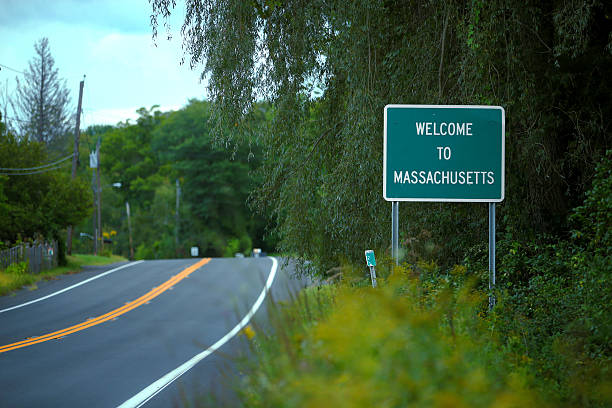
The third I just wrote last night, though the need to write a Mary Dyer poem about borders came to me last week. This was one thing that made me feel my writing is important. Because if up to now a key link between Dyer and the present has been the "nevertheless she persisted" idea, I suddenly realized that, my God and of course, the thing she determinedly did, the thing she died for, was crossing borders in defiance of anti-Quaker laws -- presenting herself as a banished "illegal" -- both out of love for Friends imprisoned on the other side, and to challenge the law through direct defiance.

So late last night the words and incantatory structure came to me, and I drafted this. And then I really couldn't sleep, I felt so charged up ("in me the afflatus surging and surging," as Whitman said, and that's what I felt). But I'm happy. This feels powerful to me, it feels like it matters.

[poem taken down during submission for publication]


Image result for welcome to massachusetts
It's a serious poem, but I found this bit amusing to include.
I don't think it detracts, though I'd have to hear from others.

Thursday, June 14, 2018

"Bones," a poem from Newport

I hope more than one piece of writing will come out of my trip to Rhode Island, but something was definitely stirring about my attempt to stand near Mary (and William) Dyer's grave site, which I wrote about in my previous post.

Here's what I drafted last night. I like it, or at least it captures exactly what I was thinking at the time and throughout the trip, the meditation on past and present I was so caught up in. Somehow, so far at least, I needed to mark clearly thoughts I was having in that place as distinct from lines of the poem as I am writing it afterwards -- that these were in fact thoughts, not lines of poetry. We'll see.

Bones

Newport, 2018

I think, the past is a locked gate:
a rusty fence surrounds the derelict
brick boxes of the Naval Hospital.
Underneath its grassy grounds, or the blacktop
beneath my feet on ordinary Cypress Street
lie the bones of Mary Dyer, martyr.
A block away, unpaved Dyre’s Gate Road
leads to a puddle, a lost child’s bike,
a path between tall rushes, railroad tracks.

I think, time itself is violence:
a grave-spot locals once showed travelers
erased now, their knowing unknown.
At water’s edge I try to view this round
collar of shoreline with its island shelter
as it met her eyes, unseeing
four centuries of human clutter.
Your own death is the least of it;
nothing you loved will last.

This flat sheen to the horizon. This sound
of small waves shushing on the beach:
how many billion, uninterrupted, each
break like a rung on a ladder you could climb
back to a day she stood here living?
I breathe and center. Sun on my hands.
Loss and loss, everything vanishing
but the innocence of ground, wind, water;
and here we are now, licking our salty lips.

Here is the sight that triggered the thought "the past is a locked gate":


Here is a partial view of where Cypress Street dead-ends at the shoreline.


A view of the Naval Hospital found on Pinterest -- this is where the Dyer farm is likely to have stood. Most of the buildings are abandoned, though there are newer active ones to the north. The end of Cypress Street is at the far left. The search for an image led to my learning that (predictably enough) it is believed to be haunted -- though not necessarily by any Dyers.


Tuesday, June 12, 2018

A Mary Dyer Pilgrimage

Last week I went to Newport, Rhode Island for several days. It had been on my mind for months as a trip I intended to take as part of my project; when I was planning the book I envisioned the conclusion taking place there, featuring my pilgrimage and direct encounter with the past. I wanted to do it to include June 1, the date of Mary Dyer's execution, and also go to Boston to see her statue there (again, I've seen it in the past). Those parts didn't quite work out, but I went on June 5 so close enough; the season was still right (the light, the look of nature). Even though it is no longer the conclusion of a book, I still want to be able to write about Newport and what it was like to go there, to have actual images for my poetry or prose.

It was a wonderful trip. My most striking experience happened on the way down, however. My first stop was in the town of Portsmouth, to see a memorial herb garden that has been created to honor Anne Hutchinson and Mary Dyer, as well as the founders of the settlement who signed the Portsmouth Compact. It was a peaceful and lovely place, set beside Founder's Brook, with birds warbling overhead in the trees. But what was amazing was that as I sat taking notes, a truck pulled up and two men and a dog got out to do some pruning. I ended up talking with one, Michael S. Ford, and it turned out he is the person who largely created the garden and maintains it; he is a 12th-generation descendant of Anne Hutchinson and an 11th-generation descendant of Mary Dyer, and a master herbalist who feels that he may have inherited this calling from them, and an amazing visual artist as well. (Unfortunately he has recently had to close his business, Apollo Botanica.) He lives an hour away and can't get to the garden all that often, so that our time there coincided felt very meaningful to both of us. We have emailed each other since then and shared some of our creative work with one another, and I've sent him a donation to buy plants. There isn't a foundation or anything supporting the garden; he's basically doing it on his own, although there is a group of women in the area who are also involved in preserving these women's memories locally. They are evidently less known there than they are within academia. . . .

Garden sign (created by Michael); garden with midwifery herbs; Michael in his garden; one of the memorial benches -- it was arresting that the Hutchinson line inscribed here is one I used in my poem "May-shine."

The challenge in the trip was how to connect with the concrete, place-based memory of Mary Dyer when no real traces of her past there visibly survive. Reflecting back, the hunt to find connection, the need to engage my imagination in doing so, to make something out of next to nothing, was actually very enjoyable, and gave me a focused and imaginative sense of pilgrimage rather than a touristic one. I had to explore as a poet/writer, not (only) as a historian, although of course I was paying close attention to the documentation more research-minded folks have collected.

Here are some things that were meaningful to me, where I felt like I was touching the past as much as it was possible to:

Between Portsmouth and Newport, a view of Dyer Island, which was claimed by William Dyer on the way down. It has always been uninhabited. Sitting on a pier here with mostly nature in view I had my closest communion with the landscape as it would have been. They saw this. So flat, so much sky -- in that sense I connected it with the feeling I get in the midwest.

Dyer Island in the distance -- it's so low you can barely make it out in the picture.

Broader view of the bay from the same site.

A view from Battery Park in Newport, which is where a spot called "Dyer Point" is, and marks the south end of the Dyer property:

I came here twice at different times of day.

This is Cypress Street, just a bit north. Experts believe the Dyer family burial plot (and the house itself) was underneath this or in the grounds of the Naval Hospital you see to the right). In the nineteenth century, multiple Dyer graves were moved to Newport's Common Burying Ground -- where one of the lanes is a "Dyre Street" as are some other little lanes near Cypress -- but William's and Mary's unmarked graves were missed. In July the Dyers' biographer/historian, Johan Winsser, is hoping to do some underground surveying to see if he can find traces. So nothing old there at all, and yet I knew I was standing as close to her body as I possibly could, and then I went to the water and was seeing the shoreline and view (if you subtracted all the development) as she would have seen it from home. I actually got tears in my eyes.

No access to the naval grounds on the right. 
Looking at the rusted chain around the gate you see here I thought, the past is a locked gate, literally and figuratively.

I had lunch at the White Horse Tavern, perhaps America's oldest inn, which was a tavern since 1673 and a site for many public meetings -- after Mary's death, but William would have gone there. There was a house there before the tavern. The interior is amazingly intact in its seventeenth-century features throughout; you really felt you were in a period interior. I brought home a souvenir glass with their logo.

I was sitting by the enormous fireplace. There were multiple rooms much like this.

The other amazing thing happened on the last day of my trip. I went to the Newport Historical Society and asked if I could see Dyer-related holdings. I was nervous because Michael had said they were patriarchal and anti-Dyer there, but I found the people I dealt with perfectly friendly and very well-informed. A famous 1905 painting of Dyer going to the scaffold turned out to be up in Providence, so the one thing I could see was a 1644 land conveyance deed signed by William and Mary Dyer and Samuel, their nine-year-old son. So there I was gazing on (although not touching!) a paper that Mary had literally looked at, upon which her hand had rested. And seeing her signature, so literate and delicately feminine.

I purchased a quality scan of the entire deed, but this is the interesting part. 
"Dyre" was the more common spelling then, Dyre/Dire/Dyer all variants not standardized yet.

Newport has been a deeply resonant place imaginatively for me not only because of Dyer, but because Jews arrived there in 1658. Sephardic Jews, so not exactly my direct ancestors, but it still felt like the clearest place my genetic/actual inheritance and my chosen spiritual inheritance occupied the same ground in 17th-century New England, the place I study. Newport is the site of Touro Synagogue, the oldest standing synagogue in the New World, and the occasion for George Washington first issuing a letter declaring religious toleration as an integral principle of the United States. It turns out that a Quaker family was central to the preservation of the structure for the many decades between when the original congregation dispersed around the Revolutionary War and when a much later Jewish immigrant population began using it again in the late 1800s -- basically the last Jew out handed them the keys and asked them to take care of it, and they did, for generations. And the Jewish cemetery a couple of blocks away was the basis for Longfellow's famous poem, which I have read and taught for years (it's highly problematic, but also very lovely, especially in its handling of sound).

Touro interior.

Well, it wasn't all colonial history. I walked on the famous Cliff Walk some, got at a least a quick drive-by peek at the amazing mansions, ate a lot of fresh seafood, breathed ocean air, and spent some time on the beach. I would very happily go back!

At Sauchest Beach in Middletown, RI.


Friday, June 1, 2018

Hello again, Mistress Dyer

So, in an interesting turn of the wheel, I have just started writing poems about Mary Dyer. Seems inevitable, doesn't it? The immediate trigger was the weekend poetry workshop on Obsession I've signed up for later in June. We have to choose our obsession in advance and do some preparatory writing about it, and bring a poem we've written on it for distribution. There are other pieces of my life I feel more truly obsessed by than Dyer, but I discovered in the memoir workshop how their deeply interior quality and limited image-set could pose problems for extended writing. Dyer, I realized, will work better, because there is so much I want to reflect on with her but she is outside me and summons so many concrete referents to draw on.

The draft of the first Dyer poem I wrote, "May-shine" (which I assume is the one I'll copy for the workshop) jumped off from my own experience. I don't know that it's finished yet but I'm excited about its layers, and how writing it took me to an end I didn't plan out. But then I wrote another, and decided to do it as a persona poem, to see what happened if I took on her voice. And wow, it flowed and I enjoyed it.
Covent Garden. Much later than ca. 1620 when the memory is set, 
but I was looking for an evocative visual of a crowded market.

[poems taken down during submission for publication]

This offers a reading of the "primal scene" I endlessly come back to in my writing, when Mary Dyer followed Anne Hutchinson out of the church as Hutchinson left after being excommunicated, and how this drew public attention to Dyer and her monstrous birth.

But the childhood memory here is entirely fictional in origin. Frustratingly (or not), we know virtually nothing about Mary Barrett's childhood and family; she didn't even necessarily grow up in London although it is likely enough, since she was a young woman there. Good circumstantial evidence (the fact that she was literate and had excellent handwriting, a trace of an elaborate embroidered silk dress and, yes, a gold bodkin believed to have belonged to her that have survived) suggests she came from a very well-off family. Well, actually, the memory is my own, transposed to a market scene: once in a bus someone spoke rudely to my mother and and despite my shyness I whipped around in my seat and denounced him vehemently for daring to speak to her that way, and wanted to rip his eyeballs out.

I feel a bit guilty about how much I enjoyed doing this! I wrote a blog post early on about my ambivalent relationship to historical fiction, how people making things up makes me cringe. But I've gone and done exactly that, and it was so much fun, felt so freeing, I can tell I'm going to do more. Go figure. Maybe poetry, which is clearly an artifice, makes it less offensive? Readers are less likely to fall into thinking they are reading something historically factual.

What I really sense writing poems in Dyer's voice might offer me is not so much the freedom to render her experience imaginatively, but to use her to talk about pieces of my own experience in a distanced way, without being endlessly autobiographical regarding my less-than-exciting outer life. She offers an intense story through which to express intense feelings and internal perceptions, and to try out ways of speaking that I could not use myself. I'm going to keep going (not planning to write only Dyer poems, but to write as many of them as I want). Maybe the book I thought I was writing will be partly replaced by a suite of poems, as well as one or more lyric essays.

I am grateful to my friend Laura Helper-Ferris for her feedback on these drafts!


P.S.:  A question for any early modern people or language experts who might read this: formal "you" and familiar "thee." In this poem, Mary and her mother are of a higher class than the imaginary trader. Am I thinking correctly that Mary would say "thee" to the trader in her childhood memory, even though she is a child and he is an adult? (I do want to emphasize her sense of superiority; the fact that she grew up with considerable privilege is an important strand in all my thinking about her, and where she got her confidence from.) And would the trader say "you" to her mother, even though he was insulting her? (I am trying to get at a degree of class resentment here.)  And would it be "how durst thee" or "how durst thou" -- isn't what I have like later Quaker speech more than correct 17th-century English? As a Quaker Mary would have "thee'd" everyone, but that's not relevant to her earlier life. You'd think I'd know this, but the social nuances don't really come up in the early stuff I read, or I wasn't paying attention to this question when I did, and Quaker plain speech sounds correct to me so it's confusing.

I just realized today's date, June 1. June 1, 1660, was the date of Mary Dyer's execution. The poem "May-shine" that I linked above is partly about the last weeks of May that led up to that; looking at the northeastern landscape in May as I thought about that time so long ago, and how it resonates.